
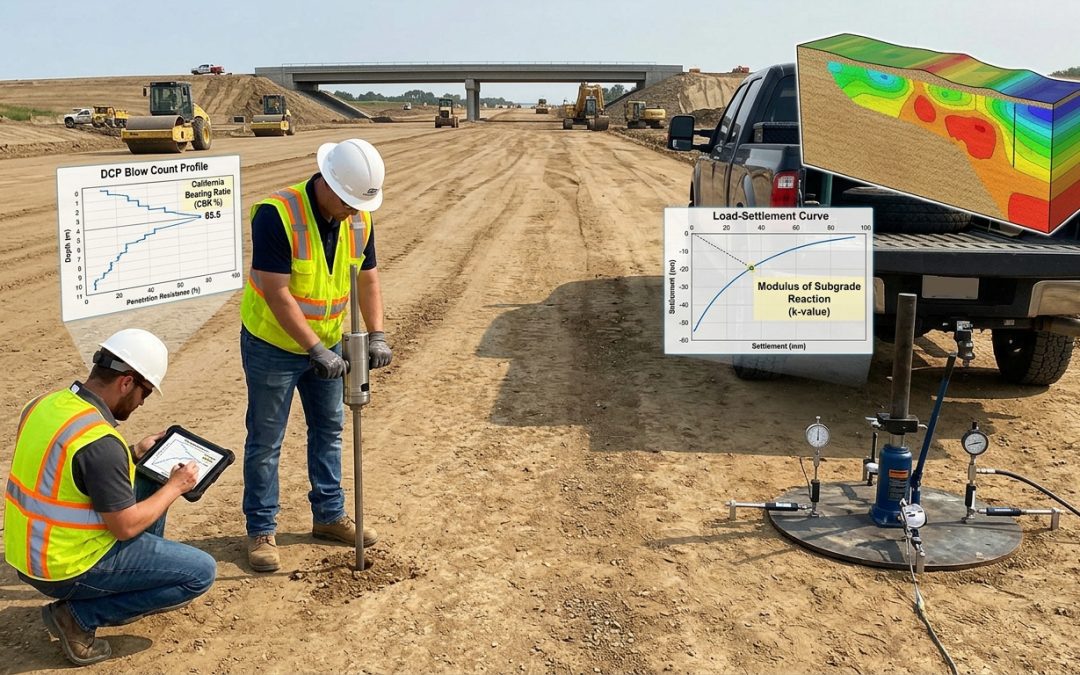
The long-term performance of any pavement, highway, or foundation is fundamentally dictated by the load-bearing capacity of the underlying soil. While laboratory testing provides a baseline for material properties, it often fails to account for the heterogeneous nature of in-situ earthworks. Soil compaction, moisture content, and density can vary significantly across a single site. When these variations are missed during the initial site investigation, the result is localized pavement failure, rutting, and costly remedial earthworks that can derail a project’s financial feasibility.
Site engineers frequently face the challenge of assessing subgrade strength in confined spaces or across vast linear projects where heavy California Bearing Ratio (CBR) equipment cannot be easily deployed. Relying on visual inspections or inadequate proof-rolling leads to “soft spots” that remain hidden until the structural layers are applied. The cost of mechanical degradation in these scenarios is massive; once the asphalt or concrete is poured, fixing an unstable subgrade requires full-depth reclamation, exponentially increasing the carbon footprint and the budgetary spend of the project.
To bridge the gap between laboratory theory and site reality, engineers utilize the dynamic cone penetration dcp test as a primary tool for rapid, in-situ California Bearing Ratio (CBR) correlation. This method involves driving a metal cone into the soil using a standardized sliding hammer, measuring the penetration per blow to determine the shear strength of the soil strata. It provides a continuous profile of subgrade stiffness down to depths of one meter, allowing technicians to pinpoint exactly where compaction has failed or where moisture ingress has compromised the soil’s structural integrity.
The Problem-Solution Pivot: Eliminating Geotechnical Blind Spots
Traditional geotechnical investigations often rely on boreholes or trial pits, which are time-consuming and provide data only at specific, isolated points. On a busy construction site, the cost of unplanned downtime while waiting for laboratory results can stifle progress. Furthermore, laboratory CBR tests on “undisturbed” samples are rarely truly undisturbed; the process of extraction and transport alters the soil’s natural state, often providing an overly optimistic or pessimistic view of its strength.
The solution is a transition toward real-time, high-resolution data collection. By utilizing portable penetration equipment, teams can perform a high volume of tests in the time it would take to dig a single trial pit. This granularity ensures that the “as-built” conditions of the subgrade match the design assumptions. If a weak layer is detected at a specific depth, immediate corrective action—such as additional compaction passes or soil stabilization—can be implemented before the next lift is placed. This proactive approach eliminates the risk of future structural settlement and the litigation risks associated with premature pavement failure.
Quantifiable Benefits of Rapid In-Situ Testing
Integrating high-frequency penetration testing into the quality control workflow yields measurable gains in project efficiency and structural reliability.
-
Cost Reduction in Remediation:
Detecting subgrade deficiencies before the pavement layers are laid reduces the cost of remedial works by up to 70% compared to post-construction repairs.
-
Efficiency Gains in Site Characterization:
A single technician can complete a full subgrade profile in under 15 minutes, representing a 400% increase in testing speed over traditional manual methods.
-
Accuracy in Design Correlation:
Direct correlation to CBR percentages allows for the optimization of pavement thickness, potentially reducing asphalt requirements by 10% to 15% through more accurate subgrade assessment.
-
Carbon Footprint Mitigation:
Minimizing the need for full-depth reclamation and reducing wasted materials contributes directly to the project’s sustainability goals and ESG reporting.
Technical Analysis: Penetration Index and Soil Behavior
The technical value of penetration testing lies in the “Penetration Index” (PI), typically recorded in millimeters per blow. This metric is not just a random number; it is a direct reflection of the soil’s resistance to vertical shear. In granular soils, the resistance is dominated by internal friction and particle interlocking. In cohesive clays, it reflects the undrained shear strength and is heavily influenced by the current moisture state.
Advanced analysis of the PI allows for the identification of the “Active Zone”—the depth to which seasonal moisture changes and traffic loads will most significantly impact soil stability. By analyzing the blow-count gradient, engineers can detect thin, weak lenses of soil that larger-scale tests might bridge over. This high-resolution vertical profiling is essential for designing resilient infrastructure in regions with complex geological histories or varying groundwater tables.
Maintenance and Mechanical Precision
Like any precision instrument, the equipment used for penetration testing is subject to mechanical degradation. The sliding hammer, the anvil, and the replaceable cones are high-wear components. If the hammer’s fall height is restricted by dirt or if the cone becomes blunted beyond the specified tolerances, the energy transfer becomes inconsistent. This leads to “data drift,” where the recorded blow counts no longer accurately reflect the soil’s true strength.
The cost of using poorly maintained equipment is the loss of data integrity. Inaccurate readings can lead to an underspecified subgrade, which in turn leads to the mechanical degradation of the entire road network. Regular inspection of the drive rods for straightness and the replacement of cones according to ASTM D6951 standards are not merely maintenance tasks; they are essential quality assurance protocols. Using a bent rod increases side friction, artificially inflating the blow count and leading to a false sense of security regarding the soil’s load-bearing capacity.
Strategic Implementation in Earthworks Management
The most effective use of this testing is during the compaction phase of embankments and sub-bases. By testing each lift, the contractor can verify that the specified density has been achieved throughout the entire depth of the layer, not just the top few inches. This is particularly vital when using heavy vibratory rollers, which can occasionally create a “crust” of high density over a looser core.
Furthermore, this method is invaluable for assessing the effectiveness of lime or cement stabilization. By testing before and after treatment, engineers can quantify the strength gain and determine exactly when the subgrade has reached sufficient stiffness to support the next construction phase. This data-driven management style reduces the reliance on “rule of thumb” curing times, allowing projects to move forward safely and efficiently.
Frequently Asked Questions
How does this test correlate to the California Bearing Ratio?
The penetration rate is converted to a CBR percentage using established empirical formulas. For most soil types, the relationship is logarithmic, allowing for a reliable estimate of soil strength that is directly applicable to pavement design software.
Can this test be used in highly rocky soils?
While effective in sands, silts, and clays, the presence of large cobbles or boulders can lead to “refusal,” where the cone cannot penetrate. In these specific geological conditions, alternative methods like plate load tests may be required to supplement the data.
What is the significance of the 60-degree cone tip?
The 60-degree angle is the global standard for this type of test, designed to provide a balance between penetration ease and the mobilization of soil shear resistance, ensuring consistent results across different geographical regions.
How many blows are typically required to complete a test?
The number of blows varies based on soil stiffness, but a test is usually continued until a depth of 1000mm is reached or until the penetration rate becomes so slow that “refusal” is recorded (typically 10 blows for less than 2mm of movement).
Is the moisture content of the soil important during testing?
Yes, moisture significantly affects soil strength. It is best practice to record the moisture state at the time of testing, as a high blow count in dry clay may decrease significantly if the soil becomes saturated later in the season.
How does hammer mass affect the results?
The standard hammer is 8kg, but for very soft soils, a 4.6kg hammer can be used to improve the resolution of the data. The formulas used to calculate CBR are adjusted based on the specific hammer mass used during the site investigation.
Why is verticality important during the test?
If the drive rods are not kept vertical, side friction increases against the rods, and the energy of the hammer is not efficiently transferred to the cone tip. This results in inaccurate, artificially high strength readings.
What are the limitations of manual penetration testing?
The primary limitation is depth; it is generally restricted to the top 1–2 meters of soil. For deeper structural foundations, heavy-duty truck-mounted Standard Penetration Test (SPT) rigs are usually required.
How often should the cone tips be replaced?
Cone tips should be replaced as soon as they show visible wear or if the diameter of the base of the cone falls below the specified tolerance. A worn cone changes the pressure distribution at the tip, compromising the accuracy of the CBR correlation.
Can this data be used for foundation design?
While primarily used for pavements and light structures, the data provides excellent insight into the consistency of shallow subsoils, helping engineers decide if deeper geotechnical investigations are necessary for larger building foundations.
Recent Comments