
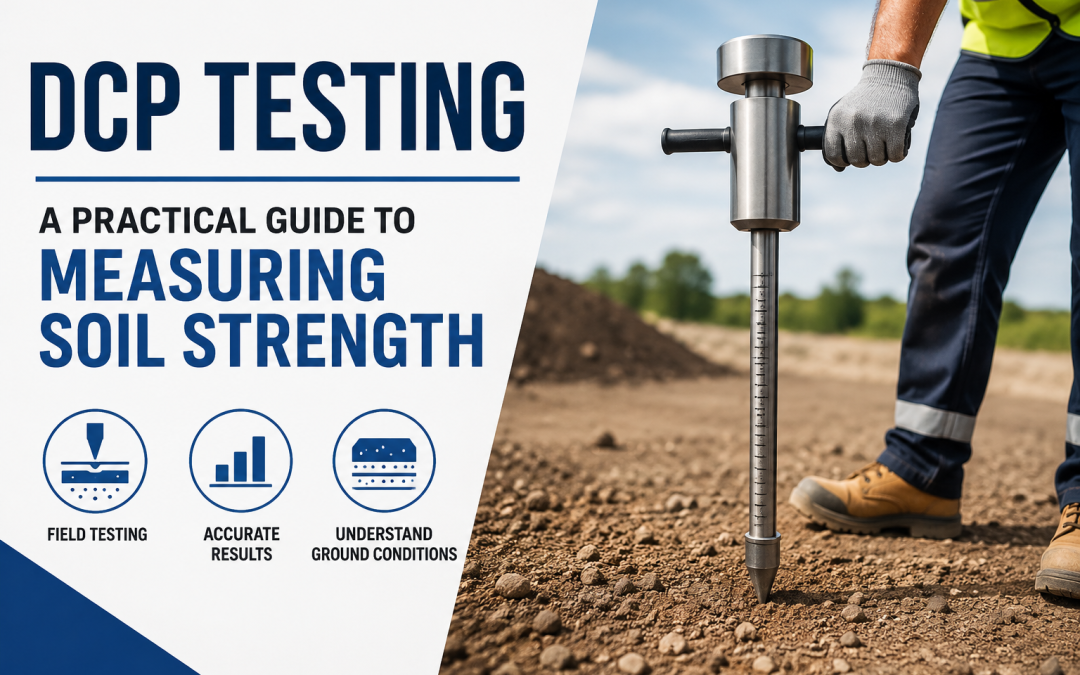
Before construction begins, one of the most important questions is whether the ground can provide enough support for the structure or pavement planned above it. Soil can look firm on the surface while weaker layers sit underneath, and those hidden changes can become serious problems once loads are applied. Good ground investigation helps engineers understand these conditions before they lead to settlement, rutting, cracking or premature failure.
Field testing provides a practical way to examine soil in its natural condition without relying entirely on samples taken away from the site. The dynamic cone penetration dcp test is one such method, using controlled hammer impacts to push a cone into the ground and record how quickly it penetrates. The resulting measurements provide useful information about the relative strength of soil and unbound materials and can help identify changes between different layers.
What Is a Dynamic Cone Penetration Test?
A Dynamic Cone Penetration Test, commonly called a DCP test, is an in-situ method used to assess the strength of soil and compacted or unbound construction materials. Instead of removing a large amount of soil for laboratory examination, the test measures resistance directly in the ground.
The basic principle is simple. A cone connected to a series of rods is driven into the soil by repeatedly dropping a known hammer through a controlled distance. After a specified number of blows, the amount of penetration is recorded. This process is repeated to produce a profile showing how the resistance of the ground changes with depth.
ASTM D6951/D6951M describes the use of an 8 kg dynamic cone penetrometer for shallow pavement applications. The method is intended for assessing in-situ strength and can be used to estimate properties such as field CBR and to identify different material layers.
The test is particularly useful because soil rarely has exactly the same condition from the surface downward. A pavement may appear well compacted near the top but contain a weaker layer below. A DCP profile can reveal that change without requiring a series of large excavations.
Why DCP Testing Matters in Construction
Ground conditions directly influence how well a pavement, road, floor or other structure performs over time. If the supporting soil is weaker than expected, loads can cause excessive deformation or uneven settlement.
DCP testing gives engineers a quick indication of ground resistance under existing site conditions. This makes it useful during site investigations, pavement assessments and construction quality checks.
One important advantage is the ability to identify variations with depth. If penetration is slow through one layer and becomes much faster below it, the change can indicate a weaker material. Similarly, consistent penetration behaviour through a compacted layer can provide confidence that the material has reasonably uniform resistance.
The method can also help identify soft spots and changes in layer thickness. ASTM notes that DCP measurements may be related to material strength, strata thickness and certain other characteristics, although the relationship depends on the material and test configuration.
How Does the DCP Test Work?
A typical test uses a steel cone, drive rods, an anvil and a sliding hammer. The apparatus is positioned vertically, and the hammer is raised to a predetermined height before being allowed to fall.
Each impact transfers energy through the rod assembly into the cone. The cone then advances into the soil. The operator measures the amount of penetration produced by a known number of blows.
The essential measurements are:
- Number of hammer blows
- Cumulative penetration
- Penetration between readings
- Penetration per blow
- Depth below the surface
The penetration per blow is commonly expressed in millimetres per blow. This value forms the basis for interpreting changes in resistance through the tested layer.
LabQuip’s DCP equipment uses an 8 kg free-fall hammer with a 575 mm drop height, while its standard configuration is intended for continuous measurements to roughly 850 mm, with an extension arrangement for deeper testing.
The exact equipment configuration matters because changing the hammer mass, cone dimensions or other test characteristics can affect the resulting correlations. Different DCP arrangements should therefore not automatically be compared as though they produced identical measurements.
Understanding Penetration Rate
The most important field observation is how far the cone travels after each group of hammer blows.
Imagine that the cone moves only a small distance after several blows. That indicates greater resistance from the material. If the cone moves much farther from the same number of blows, the layer is offering less resistance.
In simple terms:
Lower penetration per blow = higher resistance
Higher penetration per blow = lower resistance
This does not mean that every soil with the same penetration rate has exactly the same engineering properties. Soil type, moisture content, particle size, density and other factors can influence behaviour. For this reason, DCP results should be interpreted in the context of the ground conditions and the purpose of the investigation.
A field DCP result is also not automatically equivalent to a laboratory CBR result. ASTM specifically points out that a DCP measurement represents field or in-situ conditions and does not normally correspond directly to the laboratory or soaked CBR of the same material.
DCP Testing and CBR
California Bearing Ratio, or CBR, is widely used in pavement engineering as an indicator of the strength of subgrade and other unbound materials. DCP testing can be related to in-situ CBR using established empirical correlations.
This is one reason DCP testing is useful during pavement investigations. Instead of obtaining information from only one isolated sample, engineers can develop a continuous strength profile through the tested depth.
However, CBR correlations are empirical rather than universal. A relationship developed for one DCP configuration or material may not be suitable for a different setup. ASTM explains that different DCP configurations can have their own specific correlations.
Therefore, CBR estimates should be selected carefully and interpreted by someone familiar with the applicable testing method and project requirements.
Where Is DCP Testing Used?
DCP testing has a wide range of practical applications, especially where information about shallow ground conditions is required.
Road and Pavement Investigations
DCP testing is particularly associated with roads and pavement structures. It can help assess unbound base, subbase and subgrade materials and identify areas where support conditions vary.
If a road has developed rutting, cracking or settlement, DCP testing can help determine whether weak underlying layers are contributing to the problem.
Construction Site Assessment
Before placing pavement or other load-bearing layers, engineers can use DCP testing to investigate the supporting ground. The results can help identify unexpected soft zones that may require additional treatment.
Compaction Checks
A DCP does not directly measure soil density. However, where material type and conditions are reasonably consistent, penetration resistance can help highlight areas that behave differently from the surrounding ground.
ASTM notes that DCP testing can be used to identify undercompacted or soft spots in fairly uniform material through relationships between penetration and density.
Investigating Existing Pavements
The method can also be useful when an existing pavement needs assessment. Where suitable access is created through bound layers, the DCP can be used to investigate the unbound materials underneath.
Main Benefits of DCP Testing
One of the biggest strengths of the DCP is its practicality. The equipment is relatively simple, portable and designed for field use.
Fast Field Measurements
A DCP test can provide useful information within a short period. LabQuip states that a typical test can take only a few minutes, making the method practical for investigations where many locations need to be assessed.
Continuous Depth Profile
Rather than providing one isolated value, the test can show how resistance changes through the depth of the tested material.
Portable Equipment
The apparatus can be transported to different locations, including areas where access for larger equipment may be difficult.
Minimal Excavation
The test can reduce the need for extensive test pits when the investigation only requires information about shallow unbound layers.
Useful for Identifying Weak Areas
Differences in penetration resistance can draw attention to soft or poorly performing zones that may otherwise be difficult to identify from surface observations alone.
What Can DCP Results Tell You?
A well-recorded DCP investigation can provide several useful pieces of information.
First, it can show relative changes in soil resistance. Second, it can help indicate the approximate depth of different material layers. Third, it can support estimates of field CBR where an appropriate correlation is available.
The results can also provide clues about whether a layer behaves consistently. A fairly uniform penetration profile suggests similar resistance through that section, while large changes may indicate material variation, moisture differences, poor compaction or a layer boundary.
The key point is that DCP results are measurements that require engineering interpretation. They should not be treated as a complete description of every soil property.
Factors That Can Affect DCP Results
Several site conditions can influence penetration behaviour.
Soil Type
Clay, silt, sand, gravel and mixed materials respond differently to dynamic penetration. Particle size, plasticity and structure can all influence resistance.
Moisture Content
Water content can have a significant effect on soil strength. A material that performs well under relatively dry conditions may show much lower resistance when wetter.
Compaction
Poorly compacted material generally offers less resistance than a well-compacted layer of the same general type. This is one reason DCP testing can be useful for identifying inconsistent construction.
Coarse Aggregates
Large particles can interfere with penetration and produce unusually high resistance. ASTM states that the standard 8 kg DCP is not intended for granular materials containing a large proportion of aggregates greater than 50 mm.
Equipment Configuration
Hammer weight, cone geometry, rod extensions and other equipment characteristics influence the energy delivered to the ground and the relationship between penetration and strength. Results must therefore be associated with the correct test configuration.
Common Mistakes During DCP Testing
Reliable results depend on good field practice. Several simple mistakes can reduce the value of the data.
The equipment should be held vertically so that the hammer energy is transferred consistently through the rods. Poor alignment can affect penetration and introduce unnecessary variation.
The operator should also record readings carefully and consistently. Missing blow counts or incorrect cumulative penetration measurements can make later analysis difficult.
Another common issue is ignoring the condition of the cone. Excessive wear or damage can change the effective geometry of the tip and affect penetration behaviour.
It is also important not to assume that every DCP result can be converted into a CBR using the same equation. The chosen correlation must be suitable for the equipment, material and application.
Finally, unusual results should not simply be discarded. A sudden change may be the most important finding because it could indicate a distinct material layer or weak zone.
How Should DCP Data Be Recorded?
A useful field record should contain enough information for another engineer to understand exactly how the test was conducted.
Typical information includes the test location, date, operator, hammer configuration, starting depth, blow counts and penetration measurements. Moisture conditions and visible changes in material should also be recorded where relevant.
A clear table might contain:
| Blow Count | Cumulative Penetration | Penetration for Interval | Penetration per Blow |
|---|---|---|---|
| 5 | 24 mm | 24 mm | 4.8 mm/blow |
| 10 | 50 mm | 26 mm | 5.2 mm/blow |
| 15 | 67 mm | 17 mm | 3.4 mm/blow |
These values can then be plotted against depth to create a penetration profile.
The quality of the final interpretation depends heavily on the quality of the original field notes. A simple but complete record is much more useful than an unexplained final number.
When Is DCP Testing Not Suitable?
DCP testing is useful, but it is not a universal replacement for every type of geotechnical investigation.
The standard 8 kg DCP is designed primarily for shallow applications and is particularly suited to unbound soils and granular pavement materials. ASTM indicates that it is not suitable for highly stabilised or cemented materials or for certain coarse aggregate conditions.
It also should not be viewed as a direct replacement for laboratory testing where detailed material properties are required.
A DCP provides information about penetration resistance under field conditions. Other investigations may still be necessary to determine grading, plasticity, moisture content, chemical properties or other characteristics.
For this reason, DCP testing often works best as part of a broader site investigation rather than as the only source of information.
Choosing Suitable DCP Equipment
The equipment should match the test method and the type of information required. Before purchasing or using a DCP, check the hammer mass, cone dimensions, drop arrangement, measuring system and available extensions.
Durability is also important because the apparatus is repeatedly exposed to impact loading in demanding field conditions. Clear measurement markings and a straightforward design can make field operation easier and reduce recording errors.
LabQuip supplies a Dynamic Cone Penetrometer designed for rapid in-situ assessment of unbound road pavement materials. Its standard kit and optional extension arrangement are intended to support shallow field investigations while remaining portable for site work.
For organisations that regularly perform soil and construction material testing, selecting reliable equipment and maintaining it properly can help produce more consistent results.
Practical Tips for Better DCP Testing
Good testing starts with preparation. Select test locations that represent the area being investigated rather than relying on a single convenient point.
Check the equipment before use and make sure the hammer can move correctly. Inspect the cone and rods for damage or excessive wear.
During testing, keep the equipment vertical and follow the selected test procedure consistently. Record every measurement clearly rather than trying to recreate the results later from memory.
When a reading looks unusual, investigate the surrounding conditions. A soft result may indicate moisture, poor compaction or a genuine weak layer, while an unusually high reading could result from a large particle or other local obstruction.
Finally, interpret the results alongside site observations and other available data. DCP testing becomes much more valuable when the penetration profile is considered as part of the wider ground investigation.
Conclusion
Dynamic Cone Penetration testing provides a practical way to investigate the strength and consistency of shallow soil and unbound materials directly in the field. By measuring how far a cone penetrates under repeated controlled impacts, engineers can develop a useful picture of ground resistance through depth.
The method is fast, portable and capable of revealing changes that may be missed through surface inspection alone. It can support pavement investigations, identify weak areas, examine layer thickness and provide field data that may be correlated with CBR where the appropriate relationship is available.
Its value, however, depends on correct equipment, consistent field procedure and sensible interpretation. A DCP result is not simply a number to be converted without context. Soil type, moisture, compaction, equipment configuration and project requirements all matter.
For organisations looking for practical equipment for this type of field investigation, LabQuip provides DCP equipment designed for rapid in-situ testing of unbound pavement materials.
Used correctly, DCP testing can turn a relatively simple field procedure into valuable information about what is happening below the surface, helping construction and pavement decisions be based on measured ground conditions rather than assumptions.
Recent Comments