
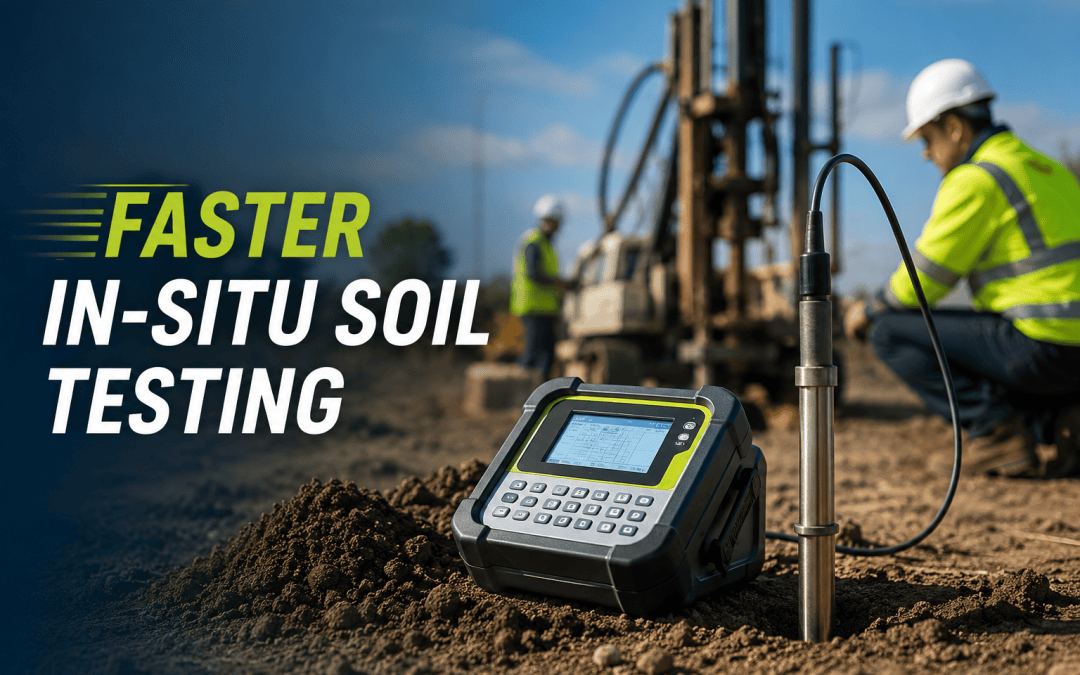
Modern construction projects depend on better ground information before major work begins. Soil conditions can change significantly across a single site, which makes early field testing an important part of planning foundations, roads, embankments, pavements and other civil engineering works. Reliable site data helps engineers reduce uncertainty, identify weaker zones and make more informed decisions before construction progresses.
Traditional ground investigations can involve several testing methods, samples, laboratory checks and detailed analysis. These approaches still have an important place in geotechnical work, but there is also growing interest in field methods that can provide useful information quickly with limited disturbance. This is especially valuable when project teams need a practical indication of soil resistance across several locations.
One of the most useful field methods in this area is the dynamic cone penetration dcp test. It provides a direct way to examine how easily a cone penetrates soil under repeated impact, creating a profile that can help indicate changes in ground resistance. The method is especially useful for practical site assessments because results can be collected in the field without depending entirely on laboratory testing. Current UK in-situ testing guidance also recognises dynamic cone penetration testing as a method for determining penetration resistance in soils.
Why Ground Conditions Need More Than a Visual Inspection
A site may appear firm, level and suitable for development, yet the material beneath the surface can tell a very different story. Layers may contain loose fill, soft zones, variable moisture conditions or compacted material with inconsistent performance.
A visual inspection can identify obvious surface problems, but it cannot reliably measure resistance below the ground surface. This is why field testing forms such an important part of ground investigation. Engineers need measurable evidence rather than assumptions based only on appearance.
Penetration testing can support this process by showing how ground resistance changes with depth. If penetration becomes easier in a particular layer, that may indicate weaker or less compacted material. If penetration becomes more difficult, the material may offer greater resistance.
This information is useful because construction decisions often depend on understanding how consistent the ground is across the wider site rather than knowing the condition of one isolated point.
Understanding How Dynamic Cone Testing Works
The basic principle behind dynamic cone testing is straightforward. A cone connected to rods is driven into the ground through repeated hammer blows. The penetration achieved from those blows is measured and recorded.
The equipment normally includes a penetration cone, rods, a hammering mechanism and a system for recording depth. During testing, the operator monitors penetration and blow counts, building a record that shows how the material responds as the probe moves deeper.
A typical DCP setup uses a cone with a defined geometry and a controlled hammer arrangement. The repeated impact creates a consistent basis for comparing penetration resistance through different layers. The field data can then be plotted to create a useful representation of subsurface variation.
The simplicity of the method is one of its strongest advantages. There is no need to remove large volumes of soil simply to obtain a first indication of relative resistance. Instead, testing can be performed directly on the ground, helping teams develop an early understanding of conditions before more detailed decisions are made.
What the Test Results Can Tell Engineers
The value of penetration testing comes from interpreting the pattern rather than looking only at one number. A site with relatively consistent penetration may suggest reasonably uniform material through the tested zone. A sudden increase in penetration could highlight a weaker layer, loose fill or a change in soil characteristics. Likewise, a sharp increase in resistance may show a denser or stronger layer.
These changes can help engineers identify areas that deserve further investigation. For example, if one section of a proposed development produces significantly different readings from surrounding locations, that difference may justify additional testing.
The results can also support assessments of subgrade behaviour, compaction and general soil strength. In pavement-related work, penetration measurements may be correlated with established engineering parameters such as California Bearing Ratio values, provided suitable correlations and project requirements are followed.
It is important to remember that penetration data is not a replacement for every other form of geotechnical investigation. The strength of the method comes from using it as part of a wider evidence-based assessment.
Where Dynamic Cone Testing Can Be Useful
Dynamic cone testing has applications across several parts of civil engineering and construction. Its portability and relatively straightforward setup make it useful in locations where teams need rapid information without introducing complex testing equipment.
Road and Pavement Projects
Road construction is one of the clearest examples. Pavement performance depends heavily on the quality and consistency of the supporting ground. Weak sections can contribute to settlement, deformation and premature damage.
Field penetration testing can help identify variations in subgrade resistance before layers are installed. This allows engineers to spot areas where additional improvement, excavation or compaction may be needed.
The method can also help with investigation work when an existing road needs assessment. Rather than assuming the entire area has similar conditions, testing can reveal whether particular sections differ from the surrounding ground.
Earthworks and Embankments
Earthworks often involve large areas with changing soil conditions. Fill materials may not be evenly compacted, particularly when placement has occurred in different phases.
Penetration testing can provide useful checks across these zones. A variation in resistance may prompt additional investigation or corrective work before the next construction stage begins.
For embankments, the information can contribute to a wider understanding of ground behaviour and help identify locations where the material response differs from project expectations.
Foundations and Building Projects
Foundation design depends heavily on ground conditions. Although a DCP assessment should not be treated as a complete foundation investigation, penetration resistance can contribute useful information during preliminary assessment.
The results may help identify changes in shallow ground conditions and highlight locations where more detailed investigation is required. This can be particularly useful during early project planning, when teams need to understand whether the site warrants deeper or more intensive investigation.
Compaction Checks
Compaction is another practical application. Newly placed soil or granular materials need to achieve suitable performance for their intended purpose. A penetration test can help indicate whether compacted areas are responding consistently. When one location shows significantly greater penetration than surrounding areas, it may suggest that the material has not achieved the same level of resistance.
Such information can support quality control, although project specifications should determine which testing methods and acceptance criteria are appropriate.
Why Portable Testing Matters on Busy Sites
Construction sites are rarely static. Access can change, machinery can move through working areas and site conditions can develop quickly. Portable field equipment provides a major practical advantage because testing can be moved between locations without requiring a large fixed installation. This makes it easier to investigate several points across a site and compare results.
Speed is another benefit. A field test can produce immediate information that supports discussions between engineers, contractors and site teams. Faster feedback can help reduce delays caused by uncertainty.
This does not mean speed should come before accuracy. Good field testing still depends on correct equipment, proper setup, consistent procedures, accurate measurement and competent interpretation.
Factors That Can Affect DCP Results
Like every testing method, dynamic cone penetration has limitations. Results can be influenced by soil type, moisture, density, grading, obstruction and other ground conditions.
Very coarse material, large stones or rock can restrict penetration and make the results difficult to interpret. The presence of unusual layers may also affect how the cone behaves.
Moisture can influence soil response as well. Two areas containing similar material may produce different penetration behaviour because their water conditions are different. This is one reason why test results should be interpreted alongside information from the wider site investigation.
The testing procedure also matters. Equipment must be suitable, measurements must be recorded accurately and the hammering process must remain consistent. Small procedural errors can reduce confidence in comparisons between test locations. For these reasons, DCP data should be considered within the context of the project rather than viewed in isolation.
DCP Testing Compared With Laboratory Investigation
Field and laboratory testing serve different purposes, so treating one as a complete replacement for the other can create problems. Laboratory tests allow engineers to examine specific material properties under controlled conditions. Samples can be tested for parameters that may be important for design, classification and construction decisions.
Field penetration testing offers a different benefit. It examines the ground in its existing condition and can provide a rapid indication of how resistance changes through the tested profile.
The two approaches can work well together. Field results may identify areas that require closer attention, while laboratory analysis can provide more detailed information from selected samples.
This combination can make an investigation more efficient because resources can be focused where the evidence suggests they are most needed.
How Better Field Data Can Support Project Decisions
One of the biggest advantages of rapid in-situ testing is improved decision-making. Suppose a project includes a large area of proposed pavement. Without sufficient field information, teams may assume that the entire subgrade behaves similarly. That assumption could lead to unnecessary treatment in stronger areas or insufficient treatment in weaker zones.
A structured testing programme provides evidence for comparing locations. Engineers can review penetration trends, identify unusual sections and decide whether additional investigation is warranted.
This can also support construction quality control. Testing carried out during different phases can help create a clearer record of how ground conditions respond following earthworks or compaction. The key is not simply collecting more measurements. It is collecting useful measurements that answer specific project questions.
Choosing a Suitable Testing Approach
The most suitable investigation method depends on the project objective, soil conditions, required depth, access and level of accuracy needed. Before testing begins, project teams should consider what they actually need to establish. Is the main concern shallow subgrade strength? Is the goal to compare compaction across a site? Is there uncertainty about fill thickness? Does the project require more detailed geotechnical parameters?
Answering these questions first helps determine whether DCP testing is appropriate as a primary field method, a supplementary method or an initial screening tool.
The testing plan should also consider the number and location of test points. A small number of readings may not represent a large or highly variable site. A sensible layout should reflect the ground model, construction zones and areas where uncertainty is greatest.
The Importance of Proper Equipment and Calibration
Reliable results begin with reliable equipment. Components should be suitable for the testing method and maintained in good condition. The cone, rods, hammer arrangement and measurement system all contribute to the quality of the final record. Worn components, damaged parts or inconsistent measurements can reduce confidence in the results.
Calibration and equipment checks are also important where required by the project procedure or applicable guidance. A properly maintained system gives technicians a stronger basis for producing repeatable results.
For organisations looking to source suitable DCP testing equipment, LabQuip Ltd provides equipment intended for field soil testing and offers technical guidance connected with its testing range.
Making Better Use of DCP Data
Collecting readings is only the first stage. The real value comes from presenting the information clearly and comparing it with the site context. Penetration depth can be plotted against blow count or related measures to show changes through the tested profile. Comparing several test points can then reveal whether the ground is consistent or highly variable.
Results can also be reviewed alongside site observations, geological information, trial pits, boreholes or laboratory findings where available. A good report should make it easy for the reader to understand what was tested, where testing took place, what was recorded and what conclusions can reasonably be drawn. Clear reporting reduces the risk of over-interpreting the data and helps the wider project team use the findings responsibly.
The Role of DCP Testing in More Efficient Site Investigations
Construction projects are under constant pressure to control costs, reduce delays and improve quality. Faster field testing can support these goals when it is used correctly. DCP testing can provide a practical way to compare soil resistance across multiple locations without creating a highly disruptive investigation process. Its portability makes it useful for early assessment, targeted checks and construction-stage monitoring.
The method also fits well within a modern approach to ground investigation, where field observations, testing data and engineering judgement are combined instead of relying on a single source of evidence.
Current UK guidance includes dynamic cone penetration within recognised in-situ soil testing methods, reinforcing its place within structured geotechnical investigations.
Final Thoughts
Good construction decisions begin with a clear understanding of what lies beneath the surface. Soil may look uniform from above, but hidden changes in density, resistance and material type can have a major effect on how a project performs.
Dynamic cone penetration testing offers a practical way to investigate these changes quickly and directly in the field. It can support road and pavement assessments, earthworks, compaction checks and preliminary ground investigations while helping teams identify locations that may need closer attention.
Its real strength comes from using the method properly. Suitable equipment, consistent procedures, accurate records and sensible interpretation all matter. When combined with other investigation techniques where required, DCP data can become a useful part of a wider ground assessment strategy.
For projects where fast, practical field information is important, a well-planned penetration testing programme can provide valuable insight before major construction decisions are made. For suitable equipment and technical support, LabQuip Ltd provides resources for DCP testing and related soil investigation work.
Recent Comments