
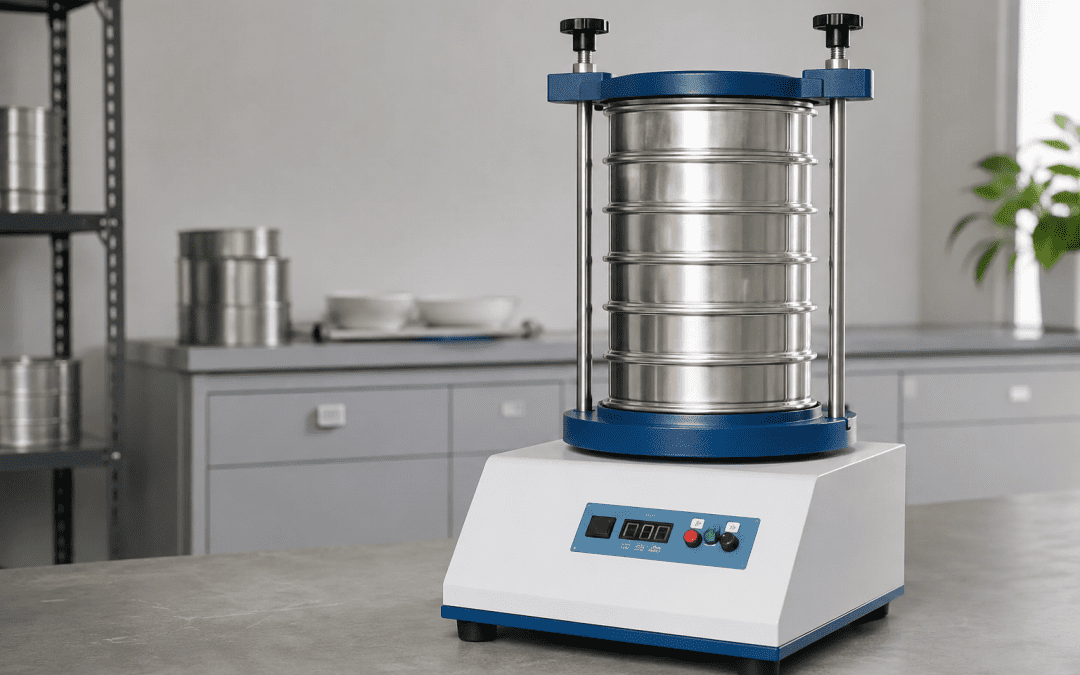
Accurate particle size distribution analysis forms the structural foundation of modern quality control across civil engineering, geotechnical assessment, and manufacturing. Material gradation dictates critical physical properties. These range from the workability and compressive strength of concrete aggregates to the compaction density of subgrade soils. When particle distribution metrics shift unexpectedly, facilities face severe consequences. These include the rejection of massive production batches, catastrophic structural weaknesses in load-bearing materials, and regulatory compliance failures. The physical mechanics of manual manipulation fail to provide the consistent vertical and horizontal agitation required for optimal particle orientation. This inconsistency frequently results in coarse-biased distributions, where smaller particles fail to navigate the mesh openings due to localized sample piling and insufficient separation energy.
The hidden costs of inefficient laboratory practices manifest rapidly. They appear in the form of extended processing hours, elevated labor overhead, and the cascading financial impact of undetected out-of-spec materials entering the downstream supply chain. Transitioning from variable manual processes to automated mechanical solutions establishes strict metrological repeatability. Integrating a high-performance sieve shaker into the testing workflow directly mitigates the operational risks associated with uneven mesh distribution and particle agglomeration. By applying highly calibrated, uniform vibratory energy, these instruments ensure that every particle receives maximum opportunities to interact with the specified mesh apertures. This fundamentally eliminates operator fatigue as a variable in critical quality assurance data while standardizing the kinetic energy applied to each test sample.
The Physical Dynamics of Separation and Mesh Blinding
Particle behavior during separation is governed by complex physical dynamics, specifically the interaction between particle morphology, moisture content, and the applied mechanical kinetic energy. Automated agitation replaces erratic manual shaking with mathematically engineered oscillation patterns. Advanced separation equipment utilizes adjustable vibration frequencies, typically ranging between 30 and 100 Hz, combined with controlled amplitude displacements of 0.5 mm to 3.0 mm. This precision creates a fluid-like moving bed of material, allowing particles to continuously reorient without prematurely degrading friable materials through excessive attrition. For highly cohesive powders or materials with heavy fine fractions, simple horizontal oscillation is insufficient. Specialized mechanisms operate at precise frequencies such as 300 vertical jolts per minute superimposed over a 2 rpm gyratory motion to break down electrostatic agglomerates and force near-size particles through the mesh. This combination of orbital material spreading and vertical tapping prevents the formation of dead spots on the mesh surface.
The persistent challenges of analytical material testing revolve around equipment degradation and specific particle behaviors. Mesh blinding occurs when near-size particles become irreversibly wedged within the wire cloth, effectively reducing the functional open area of the testing surface. This anomaly artificially inflates the retained weight values, skewing the entire geometric distribution toward the coarser end of the spectrum. Unplanned laboratory downtime is frequently the direct result of mechanical degradation caused by improper sample loading. Overloading a test screen beyond its maximum carrying capacity forces excessive weight onto the delicate wire mesh. For example, exceeding 200 grams of retained material on an 8-inch (200mm) diameter frame leads directly to wire stretching, sagging, and eventual tearing. Facilities must adopt strict volume control protocols, utilizing sample splitters and riffle boxes with slot sizes ranging from 6.3mm to 63mm to secure statistically representative batches that comply with ASTM C136 load limits. This protects the integrity of the hardware and prevents costly, unplanned equipment replacements.
Quantifying the Return on Analytical Precision
The pivot from manual methodologies to advanced mechanical separation provides immediate, measurable benefits to both laboratory throughput and overall operational expenditures. Investing in high-grade analytical equipment transforms material testing from a labor-intensive bottleneck into a streamlined, high-efficiency protocol. Automated systems allow technicians to set specific, repeatable parameters via programmable digital timers, ensuring that every batch of aggregate or powder receives the exact same duration and intensity of agitation.
This standardization yields highly specific performance metrics. Automated agitation allows for rapid processing, reducing total hands-on testing time by up to 60% compared to manual agitation. This efficiency allows laboratory personnel to redirect their focus toward complex data analysis, concrete mix design optimization, and real-time quality control adjustments. Standardized automated processes lower the frequency of re-testing caused by human error, driving a reduction in overall testing costs by as much as 25%.
| Operational Metric | Legacy Manual Processing | Automated Mechanical Processing | Quantifiable Impact |
| Throughput Efficiency | 20+ minutes per sample | 5–10 minutes per sample | 60% reduction in processing time |
| Financial Overhead | High (Labor & Rework costs) | Optimized resource allocation | Up to 25% reduction in testing costs |
| Metrological Accuracy | Variable (Operator dependent) | High (Standardized agitation) | 99% statistical confidence level |
| Equipment Lifespan | Low (Uneven loading pressure) | High (Controlled amplitude) | Significant reduction in downtime |
Integrating Precision Equipment into Laboratory Workflows
Laboratory testing parameters vary wildly depending on the material under analysis. A facility testing coarse basal aggregates requires vastly different infrastructure than a laboratory analyzing fine pharmaceutical excipients. LabQuip Ltd provides highly specialized separation systems engineered to meet the stringent demands of modern testing environments, ensuring compliance with BS 410, ISO 3310-1, and ASTM E11 international standards. The architectural diversity of the available equipment ensures that laboratories can match their exact throughput and material characteristics with the appropriate mechanical configuration. Compact benchtop models are engineered for environments with restrictive spatial limitations or lower volume requirements. These frequently utilize electromagnetic drives to provide quiet, precise operation suitable for fine, friable powders.
Conversely, high-capacity floor systems are designed for continuous, heavy-duty industrial applications, accommodating large sample volumes of coarse aggregates without suffering mechanical fatigue. To complement the agitation equipment, a comprehensive suite of laboratory test sieves is required. These analytical screens are constructed with corrosion-resistant stainless steel bodies and woven wire mesh or perforated plates. Available in standard diameters of 100mm, 200mm, 300mm, 315mm, 400mm, and 450mm, they cover aperture sizes from 1mm up to 100mm. The use of premium stainless steel naturally resists wear and tear, ensuring a prolonged operational lifespan even when subjected to abrasive geological materials.
Advanced Aggregate and In-Situ Soil Assessment
Beyond standard volumetric distribution, particle shape plays a critical role in material performance. LabQuip Ltd supplies specific Grid Sieves designed following strict guidelines that correspond with EN933-3 standards for the determination of the aggregate flakiness index. These units feature powder-coated steel frames and stainless steel bars with slot dimensions ranging from 50mm down to 2.50mm. The flakiness index is determined by finding the mean thickness of the aggregate particles, and then calculating the percentage of particles that have a thickness of less than 60% of that mean dimension. Highly flaky aggregates possess a high surface-area-to-volume ratio, which drastically lowers the workability of liquid concrete. Furthermore, flaky particles cause severe structural weaknesses that fracture under pressure from heavy loads, making them entirely unsuitable for basal and foundational structures.
Laboratory testing must also interface with field conditions. LabQuip Ltd manufactures the Soil Assessment Cone Penetrometer, widely known as the MEXE Probe. Originally designed by the Military Engineering Experimental Establishment during the Second World War to assess ground stability for heavy armored vehicles, this instrument is now a staple in civil engineering. The MEXE Probe rapidly establishes the Cone Index (CI) and the California Bearing Ratio (CBR) for in-situ ground condition analysis. This bridges the gap between laboratory aggregate gradation and immediate field-level soil stability, providing geotechnical engineers with reliable, cost-effective data prior to construction.
Environmental Variables: Wet vs. Dry Separation Configurations
Material behavior is heavily influenced by environmental conditions and inherent physical properties. Dry separation is the industry standard for granular materials, aggregates, and free-flowing powders coarser than 45 microns. However, sub-micron powders, clay bodies, and materials prone to static attraction consistently fail in dry environments due to severe mesh blinding and irreversible agglomeration. When fine particles clump together due to electrostatic forces or moisture, they behave like single large particles, preventing them from passing through the correct fine mesh and ruining the geometric data. Wet sieving configurations resolve these environmental limitations by introducing a liquid dispersal medium into the separation stack.
A continuous flow of water neutralizes static electrical charges, breaks apart cohesive clumps, and lubricates the mesh apertures. The sample is placed on the top screen and rinsed under vibration until the liquid emerging from the bottom of the stack runs entirely clear. This guarantees that ultrafine particles successfully navigate through screens without artificially inflating the retained weight of the coarser fractions. Once the process is complete, the retained material on each level is carefully dried and weighed to determine the accurate percentage distribution. LabQuip Ltd provides dedicated wet sieving solutions specifically optimized for materials that demand liquid-assisted separation, ensuring absolute accuracy in complex aggregate and fine-chemical analyses.
Maintaining Metrological Traceability and Compliance
Procuring high-end analytical equipment is only the initial step in quality assurance; maintaining the accuracy of that equipment requires strict metrological traceability. Over time, the abrasive nature of crushed rocks, metallic powders, and dense aggregates will physically erode the stainless steel wire mesh. This erosion leads to microscopic aperture enlargement, rendering the screens non-compliant and invalidating subsequent test data.
To combat mechanical drift, laboratories must classify their testing apparatus into specific tiers based on international parameters:
-
Compliance Grade Sieves: Standard manufacturing tolerances suitable for baseline quality control. The wire mesh is inspected and measured in roll quantities before installation into the individual frames, providing a basic level of accuracy and repeatability at an affordable cost.
-
Inspection Grade Sieves: Individually verified using NIST-traceable optical comparators. A specified number of mesh openings and wire diameters are measured to confirm, to a minimum confidence level of 99%, that the standard deviation meets ASTM or ISO specifications. These are essential for applications where accuracy and repeatability are highly critical.
-
Calibration Grade Sieves: The highest level of metrological certainty. These undergo exhaustive aperture mapping and are frequently tested against Standard Reference Materials (SRMs) or narrow-size glass microspheres to ascertain the actual mean opening size.
Proactive facility management includes utilizing handheld stopwatches to verify digital timer accuracy, applying optical amplitude decals to confirm vertical displacement, and employing digital accelerometers to monitor vibration frequency. Routine condition monitoring prevents the insidious drift of geometric data. Partnering with a dedicated supplier for on-site support, product calibration, and ongoing certification ensures that the laboratory’s output remains legally defensible, perfectly accurate, and highly reproducible across decades of continuous operation.
Procedural Failure Points: Attrition, Sampling, & End-Point Determination
Granular analysis begins before the material hits the mesh. Non-representative sampling ruins analytical data instantly. Operators must employ strict coning and quartering protocols or rotary sample dividers to extract a statistically valid test portion from massive bulk production batches. Once loaded into the testing stack, technicians must carefully calibrate the operational duration to prevent structural breakdown. Excessive mechanical agitation causes highly friable and fragile substrates to shatter directly against the wire cloth. This attrition mechanically induces fine dust that was not present in the original sample, artificially skewing the final geometric distribution toward the finer end of the spectrum. Conversely, inadequate shaking leaves near-size particles trapped on upper levels. To combat this, strict testing parameters demand a rigorous end-point determination. Separation is only considered statistically complete when less than 0.1% of the total sample mass manages to pass through any individual mesh opening during one additional minute of continuous physical agitation.
Advanced Aperture Mapping and Calibration Tolerances
Securing legal defensibility in material engineering requires stringent adherence to ASTM E11 and ISO 3310-1 geometric specifications. While compliance-grade equipment offers baseline tolerances, critical quality control demands tighter deviations. Mid-Point Sieves guarantee that the woven mesh falls directly in the center of the specified standard tolerance limit, effectively providing a 30% tighter operational tolerance than standard certified analytical screens. Hardware drift must be constantly monitored through advanced analytical metrology. To bypass the slow process of manual micrometer checks, laboratories increasingly utilize automated optical machine vision systems.
These systems capture high-resolution microscopic images of individual mesh openings to calculate size degradation, achieving unprecedented 92 to 97 percent time savings while virtually eliminating human reading errors. On the kinetic hardware side, tracking vertical displacement requires point-symmetrical accelerometer mounting, allowing engineers to reliably calibrate shaker stroke and displacement between 0.2 mm and 3.0 mm with less than 2 percent total uncertainty.
Monolithic Fabrication and Mesh Preservation
Mechanical degradation targets the structural seams of standard testing apparatus. Traditional screen designs frequently suffer from hidden adhesive or solder failures precisely where the woven wire cloth meets the circular metal frame. These degraded seams create microscopic crevices that trap fine particles, thereby invalidating subsequent batch weights and causing unexplainable data shifts. Advanced monolithic fabrication integrates the heavy-duty stainless steel frame and the woven wire mesh into a single, continuous physical structure, completely eliminating these structural weak points while maximizing corrosion resistance.
Preserving these highly calibrated apertures demands disciplined laboratory maintenance. Technicians must strictly avoid using aggressive compressed air jets, which easily blow out the tension of fine weaves. Cleaning protocols restrict operators to soft fiber-bristle brushes for delicate No. 100 or No. 200 screens . For extreme sub-micron meshes, physical brushing is entirely abandoned in favor of specialized ultrasonic liquid baths that safely dislodge wedged particulates without distorting the critical wire tension.
FAQ’s
What causes a coarse-biased distribution during material testing?
A coarse-biased distribution occurs when particles that should pass through a specific mesh size are artificially retained on the upper screens. This is predominantly caused by overloading the testing surface, insufficient agitation time, or severe mesh blinding. When the layer of material exceeds a few particle diameters in depth, the kinetic energy fails to push the finer fractions down to the mesh surface.
How does amplitude adjustment affect the separation process?
Amplitude dictates the vertical displacement or “bounce” of the particles on the wire cloth. If the amplitude is too low, the material remains static and clogs the apertures. If the amplitude is too high, particles float above the mesh and miss the opportunity to pass through. Adjusting the amplitude creates an optimized, fluid-like moving bed tailored to the specific density of the sample.
What is the significance of the aggregate flakiness index?
The flakiness index measures the percentage of aggregate particles whose thickness is less than 60% of their mean dimension. In civil engineering, highly flaky aggregates are detrimental because their high surface-area-to-volume ratio reduces concrete workability and introduces structural fracture points under heavy compressive loads. Specialized grid sieves are utilized to calculate this metric accurately.
When should a laboratory transition from dry to wet sieving?
Wet sieving is required when analyzing materials finer than 45 microns, highly cohesive powders, clay bodies, or substances prone to heavy static electrical buildup. The introduction of a liquid medium breaks down agglomerates and washes fine particulates through the intricate mesh openings that would otherwise immediately blind under dry conditions.
How do electromagnetic drives differ from mechanical tapping systems?
Electromagnetic systems generate a continuous, quiet, 3D vibratory motion ideal for fine, fragile, or low-density materials, effectively fluidizing the sample bed without causing particle attrition. Mechanical tapping systems superimpose a harsh vertical jolt over a gyratory motion, delivering higher kinetic impulses necessary to force coarse, dense, or heavily abrasive materials through the testing screens.
What are the maximum load limits for a standard 200mm test screen?
To prevent mechanical degradation and wire stretching, strict load limits must be observed. For a standard 200mm (8-inch) diameter frame, the retained weight on any single screen should generally not exceed 200 grams. If a sample yields a higher retained mass, the original batch must be split using a riffle box or rotary divider, and the test must be performed in multiple stages.
What is the purpose of the MEXE Probe in geotechnical testing?
The MEXE Probe, or Soil Assessment Cone Penetrometer, provides immediate, in-situ field testing of soil subgrade stability. It rapidly calculates the Cone Index (CI) and California Bearing Ratio (CBR), providing critical ground-condition data that complements the laboratory’s aggregate analysis prior to the deployment of heavy vehicles or the pouring of foundational concrete.
What distinguishes an Inspection Grade screen from a Compliance Grade screen?
Compliance Grade screens are manufactured from wire cloth that has been bulk-tested for general tolerance prior to frame assembly, providing cost-effective baseline accuracy. Inspection Grade screens are individually analyzed post-assembly using optical comparators to measure specific wire diameters and aperture sizes, yielding a documented 99% statistical confidence level.
How do Standard Reference Materials (SRMs) validate ongoing laboratory performance?
SRMs, such as highly precise glass microspheres, possess a perfectly known, highly controlled particle size distribution. By processing an SRM through the laboratory’s daily working apparatus, technicians can plot the actual retained percentages against the theoretical master curve. Any deviation indicates wire wear, mesh sagging, or mechanical drift in the shaker’s parameters.
Why is regular calibration critical for laboratory test sieves?
The abrasive nature of crushed rocks, metallic powders, and dense aggregates physically erodes the stainless steel wire mesh over time. This continuous friction leads to microscopic aperture enlargement and wire sagging. Regular calibration and verification ensure that the sieves remain compliant with international standards like ASTM E11 and ISO 3310-1, preventing the generation of invalid test data.
Final Summary
The transition from variable manual agitation to highly calibrated mechanical separation fundamentally secures material testing integrity. Manual methodologies inherently introduce operator fatigue and kinetic inconsistencies. These human variables lead directly to coarse-biased distributions and severe mesh blinding. Integrating advanced automated equipment standardizes the kinetic energy applied to each sample. These systems utilize precise vertical and horizontal oscillation to ensure optimal particle orientation against the specified wire cloth. This mechanical pivot strictly eliminates the financial drain of undetected, out-of-spec materials entering the downstream supply chain.
Implementing automated analytical hardware delivers immediate, quantifiable reductions in operational overhead. By replacing labor-intensive manual manipulation with programmable mechanical agitation, testing facilities can reduce total hands-on processing time by up to 60 percent. This specific efficiency gain frees laboratory technicians to focus on complex data validation rather than physical sample shaking. Furthermore, standardizing the separation process drastically lowers the frequency of human-induced re-testing. This operational shift drives a reduction in overall testing expenditures by as much as 25 percent while cementing a highly defensible statistical confidence level in the resulting data.
Procuring precision separation equipment is only the first step; maintaining legal defensibility demands strict, ongoing metrological traceability. The highly abrasive nature of geological and industrial materials causes inevitable microscopic aperture enlargement over time. Left unchecked, this mechanical degradation threatens compliance with rigorous international mandates such as ASTM E11 and ISO 3310-1. Securing long-term analytical accuracy requires laboratories to partner with dedicated industry specialists who provide localized on-site support, proactive hardware maintenance, and routine optical comparator verification. This continuous certification protocol prevents insidious mechanical drift, ensuring that all geometric data remains perfectly accurate across decades of continuous operation.
Recent Comments