
Construction material failures rarely happen at the macro level first. They begin as microscopic inconsistencies in laboratory testing environments where uncalibrated apparatus introduces catastrophic variables into structural engineering projects. Engineers and site managers face compounding risks when compressive strength data fails to reflect the actual batch quality poured on site. Relying on compromised testing procedures strips a construction firm of its primary defense against liability and structural degradation. The immediate consequence of flawed sample preparation is the crippling cost of unplanned structural rework and project stagnation. When laboratory equipment suffers from mechanical wear or dimensional warping, technicians inadvertently produce false negatives during compression testing. These diagnostic inaccuracies force contractors to halt operations and discard perfectly viable concrete batches, leading to severe material waste, delayed curing schedules, and entirely avoidable supply chain bottlenecks.
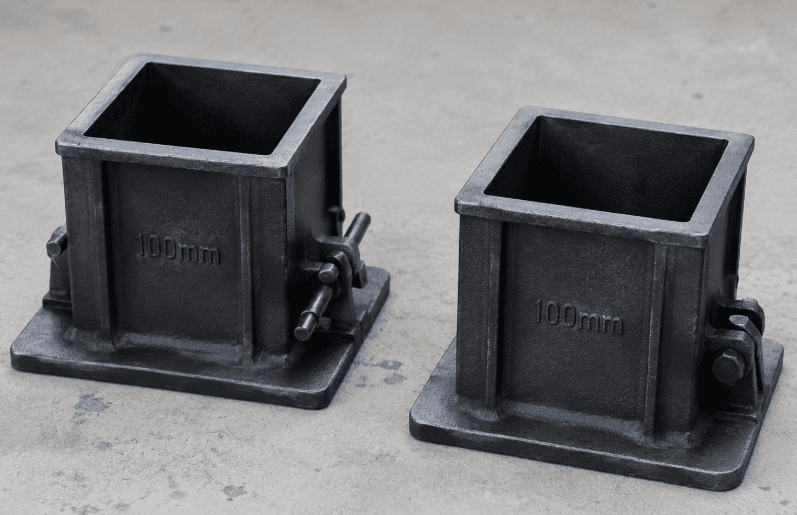
Mitigating these diagnostic errors requires rigorous adherence to strict specimen preparation protocols. The geometrical accuracy of the sample dictates the uniform distribution of load during the final destructive crush test. Using precision-machined 100mm cube moulds ensures that the cast specimens meet the exacting dimensional tolerances demanded by international regulatory standards. Even a fraction of a millimeter of deflection in the formwork can alter the internal failure plane of the concrete, rendering the subsequent strength calculations completely invalid. Standardized laboratory testing relies entirely on the rigidity of the boundary conditions surrounding the wet mix. Cast iron or high-grade steel variants provide the necessary structural mass and stiffness to withstand the aggressive mechanical vibration required during the compaction phase.
Lighter, unreinforced materials often flex outward under the hydrodynamic pressure of dense concrete, resulting in convex specimen faces that require extensive, time-consuming grinding before they can be safely placed in a compression testing machine. Maintaining absolute perpendicularity between the faces of the cured sample is non-negotiable for ISO-certified facilities. Surface irregularities directly translate to sharp stress concentrations during testing, which prematurely fracture the specimen and artificially lower the recorded yield strength. Integrating premium concrete testing equipment into your daily workflow eliminates these geometric discrepancies, permanently safeguarding the integrity and auditability of your quality assurance department.
The Diagnostic Weight of Dimensional Tolerances
Achieving compliance with BS EN 12390-1 requires an understanding that laboratory apparatus acts as a direct extension of the final architectural design. Compressive strength formulas assume a perfect geometric solid where force is applied evenly across a flawless surface area. Any deviation from a true planar surface alters the mechanics of the crush test, shifting the force from a state of pure compression into localized shear stress. This shift forces the sample to fail long before it reaches its true load-bearing capacity. Laboratories frequently encounter erratic data sets when they rely on aging or poorly maintained casting apparatus. The continuous assembly, stripping, and cleaning cycles gradually erode the mating surfaces of the side plates.
Over time, this microscopic erosion prevents the plates from sealing flush, allowing cement paste to bleed through the microscopic gaps. Paste leakage changes the water-to-cement ratio at the edges of the specimen, creating brittle zones that crumble immediately under testing platens. Auditors scrutinize these dimensional tolerances closely during ISO 17025 laboratory assessments. The standard dictates that flatness, perpendicularity, and internal dimensions must be verified with specialized calipers and feeler gauges on a strict calibration schedule. Facilities failing to maintain apparatus within the micro-millimeter tolerance thresholds risk losing their certification, immediately voiding all subsequent test reports and halting associated construction projects until corrective actions are documented.
Metallurgical Stability Under Hydrodynamic Load
The metallurgy of specimen preparation tools directly influences the reliability of the resulting data. Concrete is a remarkably dense and abrasive material, especially mixes designed with high-strength aggregates and rapid-hardening admixtures. When poured, this heavy aggregate mixture exerts significant lateral pressure against the interior walls of the casting chamber. High-carbon cast iron offers exceptional tensile strength and resistance to this continuous outward deformation, ensuring the internal volume remains perfectly static. Inferior alloys or lightweight synthetic polymers fail to provide adequate resistance to thermal and mechanical shock. The hydration process of cement is highly exothermic, generating sudden spikes in temperature that can cause lesser materials to expand and contract unevenly. This thermal cycling introduces micro-warping across the baseplates.
When a baseplate warps, it guarantees every subsequent sample cast upon it will feature a concave or convex bottom, mandating laborious capping procedures with sulfur compounds to artificially flatten the testing surface. Wear resistance is equally critical when considering the lifecycle of laboratory assets. The constant abrasion from coarse aggregates being troweled and struck off the top surface slowly degrades the upper edges of the side walls. Heavy-duty cast iron resists this friction, maintaining a sharp, ninety-degree edge that is vital for accurate volumetric measurements and density calculations. Investing in metallurgically stable tools drastically reduces the frequency of equipment replacement and minimizes ongoing calibration costs.
Vibration Dynamics and Uniform Compaction
Producing a homogeneous specimen free of entrapped air voids is the core objective of the casting process. Voids act as weak points within the matrix, drastically reducing the structural density and leading to unpredictable failure patterns. Achieving complete compaction requires subjecting the wet mix to specific frequencies on a vibration table. The mass of the casting apparatus must be sufficient to transfer these vibrational waves evenly through the concrete without bouncing or shifting off the platform. Heavy-gauge metal construction prevents the dampening of vibrational energy. If the sides of the apparatus absorb the kinetic energy rather than transmitting it, the concrete will fail to consolidate properly in the lower corners. This lack of consolidation leaves honeycomb textures on the exterior of the demoulded specimen, an automatic trigger for rejection in any rigorous quality control environment. Properly engineered equipment acts as a solid conduit for vibration, forcing air bubbles to the surface swiftly and efficiently.
Manual tamping protocols also require a rigid boundary to be effective. When technicians use steel tamping rods to consolidate layers of concrete by hand, they strike the interior bottom and sides of the setup repeatedly. Flimsy materials will dent, scratch, or gouge under the impact of the tamping rod. Deep scratches become physical anchors for the curing cement, making demoulding incredibly difficult and often resulting in spalled edges when the technician forcefully extracts the hardened sample.
Quantifiable Gains in Quality Assurance Workflows
Transitioning to high-precision laboratory assets yields immediate, measurable improvements in departmental efficiency. Laboratories operating with meticulously maintained equipment report up to a 15% reduction in false-negative test results. This specific metric directly translates to massive cost savings for contractors, as they no longer need to commission expensive, non-destructive core drilling tests on existing structures just to verify batches that were falsely flagged by faulty lab work. Workflow velocity also increases when physical sample preparation is streamlined. Technicians spend an average of two to three hours a week grinding the uneven faces of poorly cast concrete samples to make them suitable for the compression machine.
By ensuring the cast is geometrically perfect straight out of the curing tank, laboratories eliminate this grinding phase entirely. This efficiency gain allows personnel to process higher volumes of tests per shift without compromising analytical accuracy. Lowering the rejection rate of the physical samples themselves saves significant administrative overhead. Every rejected specimen requires a formal non-conformance report, secondary reviews by senior engineers, and client communications to explain the delay. Eradicating equipment-induced deformities means fewer administrative bottlenecks, faster report turnaround times, and stronger trust between the testing facility and the site engineers relying on their immediate feedback.
Optimizing Surface Friction and Demoulding Mechanics
The interface between the raw concrete and the interior wall of the apparatus dictates the physical integrity of the demoulded sample. Cement adheres aggressively to porous or micro-scratched surfaces during the hydration phase. To counteract this bonding, technicians apply specialized release agents. However, the efficacy of demoulding oils is heavily dependent on the surface finish of the metal. Precision-milled steel provides a frictionless canvas where a microscopic layer of oil is sufficient to prevent adhesion. Applying excessive force during the demoulding process introduces invisible micro-fractures into the young concrete. At 24 hours old, a specimen has only achieved a fraction of its final strength and is highly susceptible to impact damage.
If a technician must use a rubber mallet excessively to separate sticky side plates, they are silently damaging the internal matrix of the cube. These hidden impact fractures will manifest later as drastically reduced compressive strength readings. Proper maintenance of the internal faces ensures a smooth, vertical release every time. Standard operating procedures dictate that all internal surfaces must be thoroughly cleaned with non-abrasive brass brushes immediately after stripping, before residual slurry can harden into rock. Failing to maintain this pristine surface finish causes sequential degradation; a single uncleaned spot of hardened cement will gouge the next sample, compounding the demoulding difficulty with every subsequent cast.
Thermal Mass and Early-Stage Hydration Regulation
The initial 24 hours of concrete curing are the most sensitive to environmental variables. The chemical reaction between water and cement compounds generates localized heat, which must dissipate evenly to prevent thermal cracking. Heavy cast-iron apparatus possesses a high thermal mass, meaning it absorbs and distributes this exothermic heat slowly and uniformly across all faces of the specimen. Uniform temperature regulation prevents moisture gradients from forming within the sample. If one side of the concrete cools significantly faster than the core, the resulting differential shrinkage causes internal microscopic tearing.
Plastic or thin-walled alternatives fail to insulate the concrete or absorb the heat effectively, leaving the specimen entirely vulnerable to ambient temperature fluctuations in the laboratory environment. Consistency in the early curing environment is what allows laboratories to compare day-to-day batch results accurately. If the thermal boundary conditions shift based on the specific equipment used for a given sample, the resulting strength data will feature unexplained variances. Standardization demands that every variable, including the rate of heat dissipation during early hydration, is controlled and replicated perfectly across the entire testing program.
Preventative Maintenance and Calibration Standards
Equipment degradation is a silent variable that corrupts historical data sets. To maintain ISO 17025 accreditation, testing facilities must implement rigorous, documented preventative maintenance schedules for all physical assets. This protocol extends far beyond simple cleaning; it requires the routine application of rust inhibitors, the inspection of threading on assembly bolts, and the verification of mating surface alignments. Corrosion is the primary enemy of precision metalwork in a wet laboratory environment. When unprotected iron is exposed to the highly alkaline moisture of wet concrete, oxidation occurs rapidly. Pitting corrosion on the interior faces alters the volumetric capacity of the cast and creates mechanical locks that hinder demoulding.
Technicians must submerge disassembled components in specialized mineral oils or apply protective film barriers at the end of every testing cycle to halt oxidative degradation. Routine dimensional verification is the final safeguard against drift. Laboratory managers must utilize calibrated go/no-go gauges and precision micrometers to measure the internal width, depth, and diagonal cross-sections of the assembled apparatus every quarter. Tracking these minute dimensional shifts over time allows facilities to retire wearing assets long before they reach the critical failure threshold, ensuring that the laboratory never issues a compromised analytical report to a structural engineer.
FAQ’s
What is the acceptable dimensional tolerance for a concrete testing specimen under BS EN 12390-1?
According to BS EN 12390-1, the designated dimensions of the cast specimen must not deviate by more than 0.5% from the nominal size. Furthermore, the flatness of the load-bearing surfaces must remain within 0.0005 times the nominal dimension to prevent uneven stress distribution.
How does apparatus rigidity affect the compressive strength outcome?
Rigidity prevents outward bowing during the vibration and compaction phases. If the sides flex under hydrodynamic pressure, the resulting sample will have convex faces. Testing a convex sample concentrates the machine’s load on a single high point, causing premature structural failure and falsely low strength readings.
Why do ISO standards prioritize cast iron over plastic for high-volume testing?
Cast iron provides superior metallurgical stability, thermal mass, and resistance to abrasion. It withstands the violent forces of vibration tables and manual tamping rods without warping or scratching, ensuring decades of consistent geometric accuracy that synthetic polymers simply cannot sustain.
What is the correct method for applying release agents prior to casting?
Release agents should be applied as an exceptionally thin, uniform film using a fine brush or cloth. Pooling oil in the corners must be strictly avoided, as excess fluid displaces the concrete matrix, resulting in soft, porous corners that compromise the structural integrity of the sample.
How frequently should laboratory equipment be recalibrated for dimensions?
ISO 17025 guidelines generally recommend a full dimensional calibration of casting apparatus at least once every 12 months. However, high-volume facilities or those working with highly abrasive aggregate mixes should implement internal verification checks every 3 to 6 months using calibrated micrometers.
Can surface rust on testing apparatus compromise the concrete sample?
Yes. Surface rust creates a porous, high-friction texture that binds aggressively to curing cement. This makes demoulding difficult, increases the risk of micro-fracturing the specimen during extraction, and leaves irregular pits on the surface that disrupt uniform load distribution during the crush test.
What causes a concrete sample to fail prematurely during a crush test?
Premature failure is almost always linked to geometric flaws rather than material weakness. Non-parallel load faces, convex surfaces, entrapped air voids from poor compaction, or internal micro-cracks caused by forceful demoulding will all trigger early fracturing under the testing platen.
How does improper bolt torqueing alter sample geometry?
If assembly bolts are tightened unevenly, the side plates will not sit perfectly perpendicular to the baseplate. This misalignment forces the concrete to cure into a slight parallelogram rather than a perfect cube, introducing severe shear forces during compression testing that invalidate the results.
What are the signs of mechanical degradation in specimen preparation tools?
Key indicators include visible light passing through the seams of the assembled joints, leakage of cement paste during vibration, difficulty in aligning the bolts during assembly, and concrete samples consistently requiring physical grinding to achieve planar testing surfaces.
How does the thermal mass of the apparatus influence early-stage concrete hydration?
Heavy metal construction absorbs and dissipates the intense exothermic heat generated by curing concrete evenly. This prevents severe temperature differentials between the core and the surface of the specimen, eliminating the risk of thermal shock and micro-cracking during the critical first 24 hours.
Summary
The physical integrity of a multi-million-pound infrastructure project ultimately rests on the compressive strength data derived from a single laboratory sample. Tolerating dimensional inaccuracies or mechanical degradation in your casting apparatus introduces an unacceptable layer of risk into the entire construction timeline. False-negative readings caused by warped or degraded moulds do more than just halt site operations; they mandate expensive non-destructive field testing and erode the critical trust between testing facilities, structural engineers, and project stakeholders. Transitioning to meticulously calibrated, heavy-duty testing equipment is a fundamental risk management strategy rather than a simple operational upgrade.
By eliminating the hidden variables of outward hydrodynamic deflection, thermal warping, and micro-fracturing during the demoulding process, laboratories secure the unquestionable accuracy of their analytical reports. Investing in high-grade, metallurgically stable assets directly correlates to streamlined daily workflows and drastically reduced sample rejection rates. When the geometric accuracy of the specimen is guaranteed straight out of the curing tank, quality assurance departments eliminate administrative bottlenecks and ensure the uninterrupted maintenance of their ISO 17025 accreditation. In the rigorous environment of standardized material testing, true quality control leaves zero room for dimensional error.
Recent Comments